
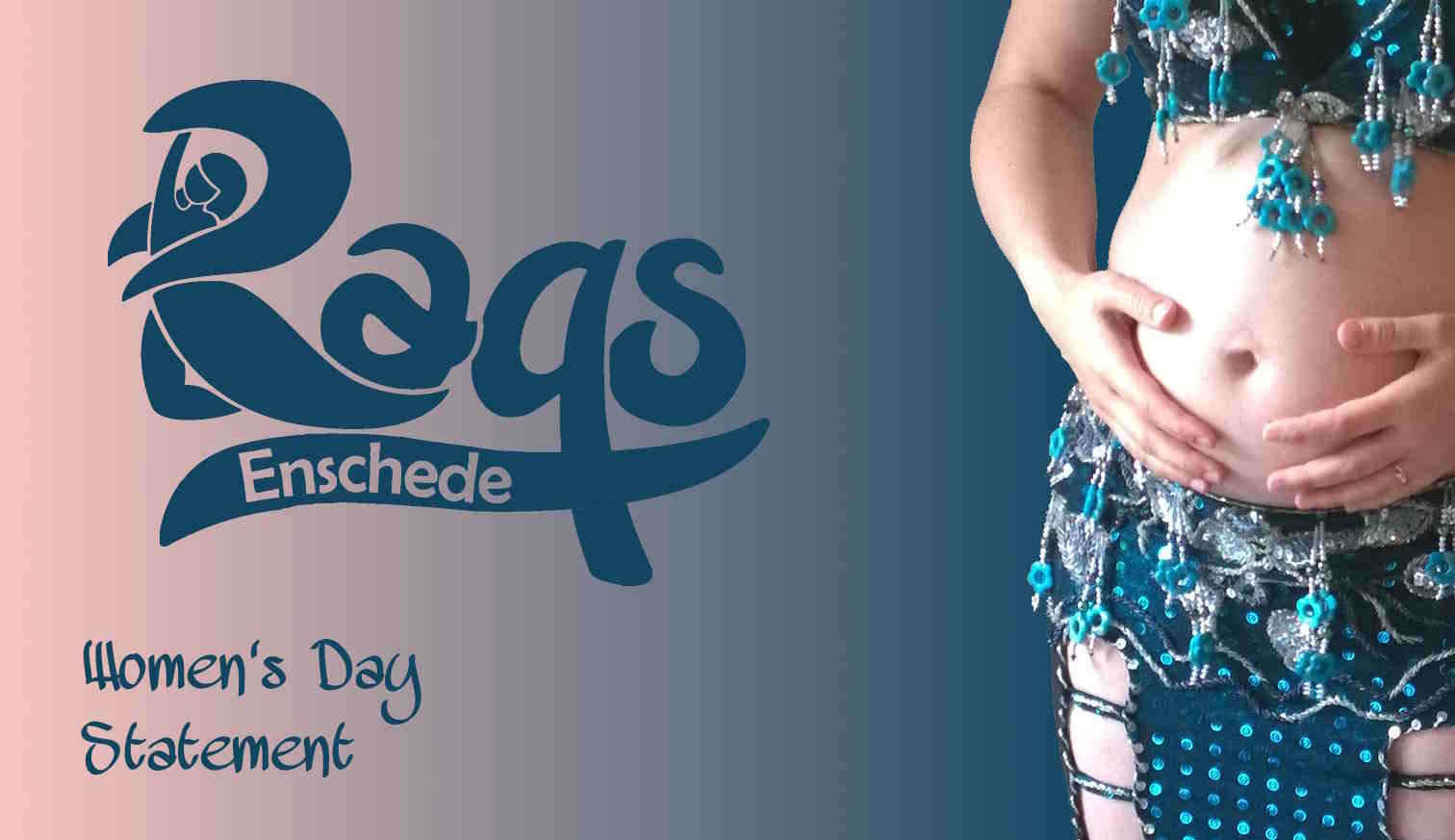
Statement of Raqs Enschede – International Women’s Day
By: Cynthia Dorrestijn
When I say I’m a belly dancer, it provokes all kinds of reactions. People project many different things on me:
- The belly dancer as seductress: Old Dutch men who reveal with their gaze that they suddenly see me as a sex object, causing me to avoid their gaze.
- The belly dancer as princess. Young girls who are fans of the shiny dance costumes and want to be like Jasmine from the story of Aladdin at their children’s party.
- The belly dancer as a strictly feminine phenomenon. A Muslima who is only allowed to take dance lessons by her husband if it is exclusively for women. And the trans person who, for that very reason, would like to take lessons.
- The belly dancer as part of patriarchal exploitation. An acquaintance was threatened to be canceled simply because of vacation photos in which he is embracing a scantily dressed belly dancer.
- The belly dancer as an entertainer: Being asked to enrich an Arabic celebration with belly dancing.
- The belly dancer as a strictly Middle Eastern phenomenon. An Egyptian woman who says to me, a white woman, on Facebook: “You are massacring Egyptian culture.”
None of these projections have anything to do with why I love to dance this dance. I dance to Arabic music because I love the music. I dance with characteristic belly dance movements because it feels incredibly good and natural. These movements make me feel feminine and empowered.
To me, dancing is about taking up space by moving. Taking up space is not a given for many of us. Think, for example, of how you sit in a crowded train. I don’t think I’m the only one who sometimes keeps my legs together tensely, because touching the leg of the man next to me could lead to an unpleasant interaction. Saying that you “brought it on yourself” is one of the most appalling justifications for sexually transgressive behavior. My openly sensual way of dancing is therefore an act of rebellion.
When I’m cold, and when I’m happy, I shake my hips. You see me doing it to cheerful Arabic music, but also in a cold bus shelter in winter, waiting for the bus. What does it tell us that we find pelvic and hip movements so offensive? These are movements in precisely that area that we associate with fertility. The urge to control fertility is one of the pillars of widespread systemic injustice. To me, the freedom of movement in belly dancing feels like a celebration of fertility.
Raqs Enschede knows about these sensitivities and backgrounds. Therefore it is a good place to be when one is engaged in feminism.